In the landscape of December 2025, where artificial intelligence workloads are generating heat densities surpassing one hundred kilowatts per rack and edge computing demands agile deployments, the server room cooling system has advanced significantly, incorporating hybrid liquid-air solutions and AI-optimized controls to ensure reliable performance and sustainability.
Understanding the Need for Specialized Cooling
Server rooms, as the core of digital operations, produce primarily sensible heat from electronic components with negligible moisture, necessitating cooling systems that far exceed standard air conditioning capabilities. Traditional units, focused on human comfort, operate cyclically and emphasize latent heat removal, resulting in inefficiencies such as temperature fluctuations and hotspots that can lead to processor throttling or hardware failures. A dedicated server room cooling system sustains temperatures between eighteen and twenty-seven degrees Celsius with variations under one degree, and relative humidity from forty to sixty percent to prevent condensation and electrostatic issues. In 2025, with data center cooling markets valued at around twenty point eight billion dollars and projected to reach forty-nine point nine billion by 2034 at a ten point two percent compound annual growth rate, these systems are essential for managing the exponential rise in artificial intelligence demands that spike heat unpredictably. Their non-stop operation and quick adaptability avert downtime, which can exceed one hundred thousand dollars per hour in sectors like cloud computing or e-commerce.
Evolution and Current Market Overview
The progression of server room cooling started with perimeter-based units in the mid-twentieth century, advancing to digital-controlled systems in the nineteen eighties for better precision. The two thousands introduced variable-speed technologies driven by energy concerns, and today, in December 2025, the global market stands at approximately eighteen point seven eight billion dollars, expected to grow to forty-two point four eight billion by 2032, reflecting the shift toward modular and efficient designs amid hyperscale growth. This expansion is propelled by the need to address limitations in legacy air methods for high-density racks now over eighty kilowatts, fostering adoption of in-row, rear-door, and hybrid configurations. As worldwide data volumes surge beyond two hundred zettabytes, server room cooling systems are evolving into scalable solutions suitable for small enterprise spaces to massive cloud infrastructures, emphasizing sustainability and reduced carbon footprints.
Operational Dynamics of Modern Systems
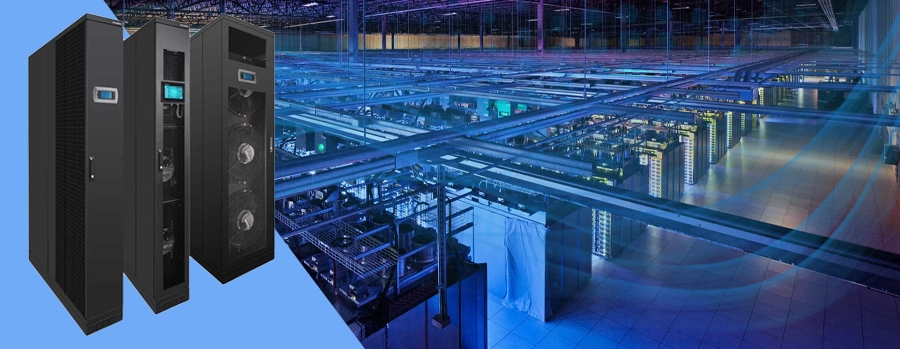
A server room cooling system functions through a refined closed-loop refrigeration mechanism designed for unwavering reliability. Hot exhaust from servers is pulled over evaporator coils, where refrigerant captures thermal energy, cooling the air before it is redistributed via precise pathways like underfloor plenums or direct rack ducts. Inverter-driven compressors pressurize the refrigerant, expelling heat through condensers that may be air-cooled for ease or water-cooled for optimal efficiency. Humidity is controlled meticulously with dehumidification processes that extract moisture without excessive cooling, often augmented by steam humidifiers during dry periods. Sensors monitor parameters multiple times per second, relaying information to advanced controllers employing proportional-integral-derivative algorithms for immediate corrections. Rack-mounted variants integrate cooling within cabinets, minimizing air travel for swift handling of load shifts from intensive computing tasks, offering capacities from twenty to one hundred ten kilowatts and airflows up to fifteen thousand cubic meters per hour to dissipate heat effectively.
Types and Adaptable Configurations
Server room cooling systems feature various types to accommodate specific requirements and site limitations. Air-cooled direct expansion setups utilize outdoor condensers to release heat, perfect for areas without water resources, managing twenty to eighty kilowatts with environmentally friendly refrigerants yielding efficiency ratios up to twenty-eight point nine in free cooling. Water-cooled models link to chilled circuits or towers, providing enhanced savings in expansive facilities by utilizing waste heat elsewhere. Chilled-water options ensure even coverage in large rooms, scaling from thirty to ninety kilowatts through automated valves. Rear-door heat exchangers convert rack doors into dynamic cooling panels, enabling high-density without additional footprint. In-row systems situate between cabinets, pulling hot air horizontally for instant conditioning, while overhead designs fit non-raised floor environments. Hybrid arrangements fuse air precision with liquid immersion, where fluids directly address component heat in artificial intelligence setups, supported by air for ambient control. These configurations prioritize modularity, facilitating incremental expansions as computational needs evolve.
Advantages Enhancing Operational Resilience
Adopting an advanced server room cooling system provides substantial benefits in efficiency, dependability, and eco-friendliness. Variable-speed elements and intelligent management decrease energy use by up to fifty percent under varying loads, typical in fluctuating workloads, contributing to power usage effectiveness metrics below one point one five when combined with containment strategies. This addresses cooling’s significant portion of data center power consumption, reducing costs and emissions via innovations like adiabatic pre-cooling that uses evaporation to cool intake air. Redundancy through dual circuits and seamless failover maintains service during outages or upkeep, critical as interruptions average over one hundred thousand dollars per hour in digital services. High-efficiency filtration shields hardware from contaminants, prolonging durability, while accurate humidity prevents corrosion and static disruptions that risk data integrity. In 2025, alignment with sustainability mandates comes via low-global-warming-potential refrigerants and heat repurposing, channeling exhaust for building warmth to support net-zero ambitions.
Synergistic Airflow and Technological Integrations
To maximize efficacy, server room cooling systems pair with optimized airflow architectures. Hot aisle cold aisle separations isolate intake and exhaust, with enclosures elevating capacity by thirty to fifty percent via limited recirculation. Close-coupled rack integrations perform optimally, seizing heat at its origin for rapid removal. In December 2025, key integrations involve AI-enhanced optimizations forecasting requirements from trends and external inputs, curbing energy by thirty percent, and closed-loop waterless cooling that eases grid pressure with subterranean thermal reservoirs. Emerging chillers boast leading power reductions and no on-site water usage, operating silently, while liquid trends cater to artificial intelligence with precision, ensuring waste-free efficiency. These enhancements tackle the rigorous needs of powerful servers, surpassing traditional air constraints.
Proactive Maintenance for Sustained Performance
Maintaining a server room cooling system entails rigorous routines to secure longevity and peak output. Monthly filter changes avoid clogs that might inflate energy demands by twenty-five percent, and quarterly coil scrubs sustain heat exchange while curbing bacterial proliferation. Yearly refrigerant evaluations identify leaks promptly, upholding performance and regulations. Motor lubrication and alignment verifications mitigate wear, extending life by five to eight years. Calibrations of sensors preserve precision, and electrical reviews prevent dangers. Predictive analytics scrutinize vibrations and patterns to anticipate breakdowns, enabling fixes in low-activity phases without halts. Rack-mounted designs offer modular entry, simplifying procedures without repositioning, and syncing with IT timelines lessens effects. This strategy diminishes repair expenses by twenty-five to thirty-five percent and upholds warranties, ensuring dependability in intensive operations.
Forward-Looking Trends in 2025
By December 2025, server room cooling systems are swiftly progressing to accommodate artificial intelligence’s intensifying needs. Liquid immersion hybrids are standardizing, merging fluid prowess with air reserves for densities surpassing one hundred kilowatts per rack. Projections show market escalation past fifty billion dollars by 2030, motivated by edge advancements and eco-regulations. Exhaust repurposing and adiabatic supports are commonplace, diminishing environmental impacts, while automated inspections via drones improve safety in expansive sites. For investigating diverse suppliers, server room cooling system link alternatif materials frequently spotlight supplementary innovators and progressive choices.
In essence, the server room cooling system forms the foundation of sturdy data frameworks, integrating accuracy with pioneering efficiencies to confront the hurdles of a data-dominated age.